
The Future of Translation: AI in Action
In today’s interconnected world, language barriers are quickly becoming a thing of the past. Ai translation tools are revolutionizing global communication, enabling businesses to connect with diverse audiences more effectively than ever before. Powered by artificial intelligence in translation, these tools streamline multilingual communication and are rapidly becoming indispensable for companies operating on a global scale.
This article explores how Ai translation tools work, their benefits, best practices for implementation, and their transformative role across industries like healthcare, legal, and e-commerce. We’ll also answer key questions and help you identify the best solutions for your needs.
Understanding Ai translation tools and Its Benefits
How Ai translation tools Works
Ai translation tools rely on advanced technologies such as neural machine translation (NMT) and natural language processing (NLP) to deliver high-quality translations. These systems analyze not just words but also the context, tone, and cultural nuances in Ai translation tools, ensuring more accurate communication across languages.
Unlike traditional translation methods, AI-powered systems can process vast amounts of text almost instantly. They adapt to different languages, dialects, and industry-specific jargon, making them highly scalable for growing businesses.
Benefits of AI Translation Tools

AI translation tools have rapidly transformed the way individuals and organizations approach language translation, offering a wide array of advantages across speed, cost, scalability, and quality.
Speed and Efficiency
- AI translation tools deliver human-like translations in seconds, enabling organizations to translate large volumes of content rapidly. This speed is especially valuable for real-time applications, such as live events, customer support, or international conferences, where immediate translation is critical.
- By automating routine and repetitive translation tasks, AI tools allow human translators to focus on more complex or creative work, further boosting overall productivity.
Cost-Effectiveness
- Utilizing AI translation significantly reduces the costs associated with hiring human translators for every project. AI can handle vast amounts of content without the incremental costs that come with scaling up human resources.
- Smaller companies or those with limited budgets can access high-quality localization and expand globally without prohibitive expenses.
Consistency and Quality
- AI translation tools ensure consistent use of terminology, tone, and style across all translated materials, minimizing errors and discrepancies that might arise from different human translators.
- Advanced AI models leverage contextual understanding and deep learning to improve translation accuracy and adapt to specific industry jargon or stylistic preferences.
Scalability
- AI-powered translation solutions can process multiple languages and large volumes of content simultaneously, making them ideal for organizations expanding into diverse global markets.
- This scalability allows for rapid localization of websites, product documentation, and marketing materials, supporting international growth.
Customization and Continuous Improvement
- AI translation systems can be tailored to specific industries (such as legal, medical, or technical fields) to ensure accuracy and relevance for specialized content1.
- These tools continuously learn and improve from user feedback and new data, leading to progressively better translation quality over time.
Accessibility and Global Reach
- AI translators break down language barriers, making content accessible to a wider audience and enhancing customer engagement in real time.
- They enable businesses to connect with customers across different regions by providing localized content, boosting brand recognition and trust.
Versatility and Ease of Use
- AI translation tools can handle a variety of content types, from text documents and websites to subtitles for movies and real-time spoken conversations.
- They are user-friendly, requiring minimal setup-users simply input text or upload documents to receive instant translations.
Enhanced Project Management
- AI can assist in project management by estimating the quality of localization jobs, optimizing workflows, and providing data-driven insights for continuous improvement2.
Summary Table: Key Benefits of AI Translation Tools
| Benefit | Description |
| Speed | Translates content in seconds, supporting real-time and high-volume needs |
| Cost-Effectiveness | Reduces translation costs, making localization accessible to all business sizes |
| Consistency | Maintains uniform tone and terminology across all content |
| Scalability | Handles multiple languages and large content volumes simultaneously |
| Customization | Adapts to industry-specific terminology and style |
| Accessibility | Expands global reach and improves customer engagement |
| Versatility | Translates diverse content types (text, audio, video, websites) |
| Project Management | Optimizes workflows, estimates quality, and highlights bottlenecks |
| Continuous Improvement | Learns from feedback, improving translation quality over time |
AI translation tools are revolutionizing global communication and localization, offering unmatched speed, cost savings, and scalability while maintaining high quality and consistency.
How to Get Started with Ai translation tools
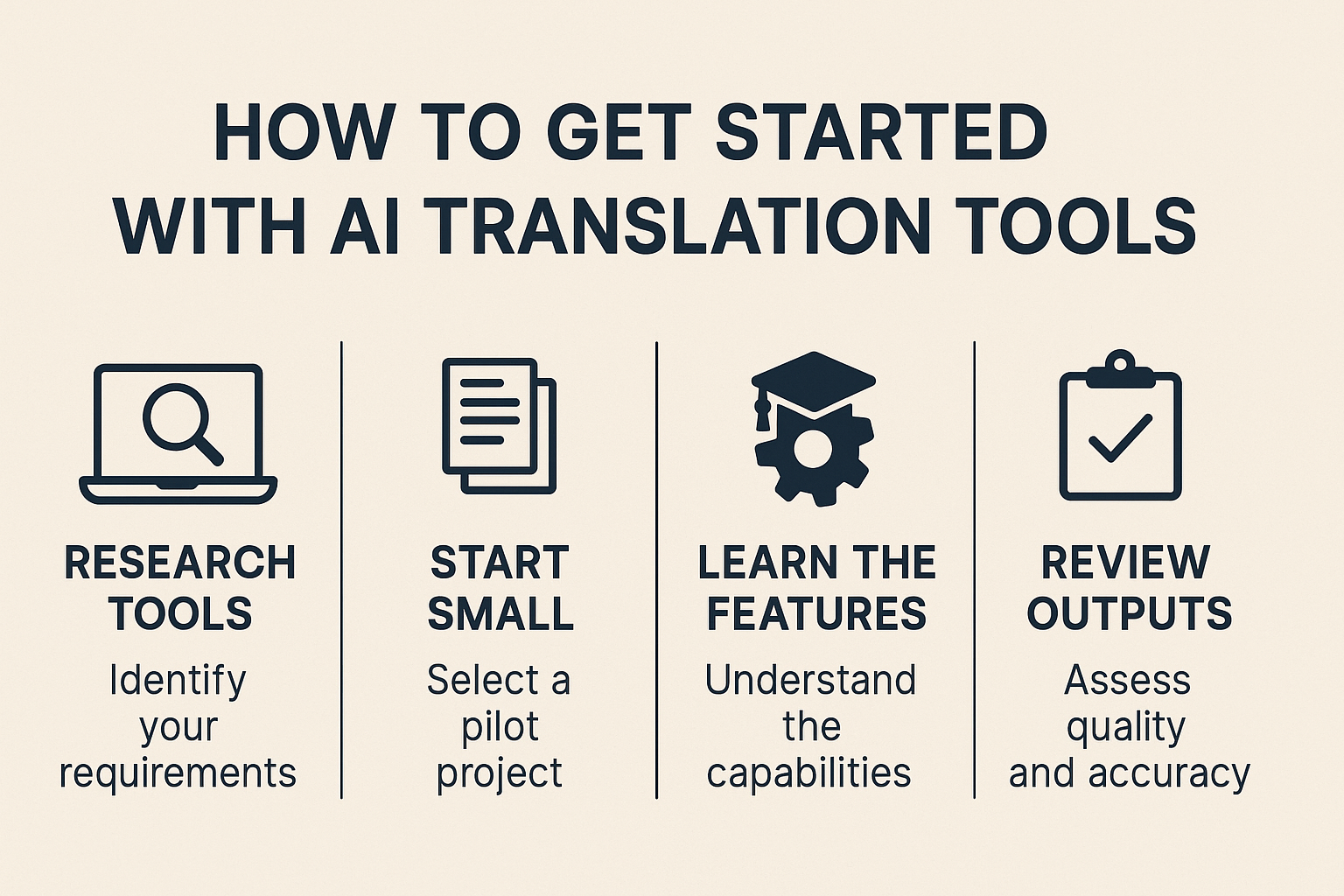
Evaluate Your Needs
Before implementing AI, businesses should assess their translation requirements:
- What content needs translating? Marketing, legal, or technical?
- Is AI in healthcare translation or AI tools for legal document translation more applicable to your industry?
Choose the Right Ai translation tools Tool
When selecting a tool, consider:
- Accuracy and linguistic quality
- Support for regional dialects and niche industry terminology
- Integration capabilities with existing workflows
Top options include DeepL, Google Translate, and Amazon Translate, which offer advanced features like glossaries, real-time translation, and API integrations.
Integrate AI into Your Workflow
Integrating AI tools with your existing platforms like CRM or CMS can enhance operational efficiency. For example, AI tools can be customized using translation memories and glossaries to adapt AI for different languages.
Learn how Technical Documents Translation services can complement AI tools for precise, industry-specific results.
Making the Most of Ai translation tools
To ensure the best outcomes:
- Combine AI with human expertise to preserve linguistic and cultural accuracy
- Use Ai translation tools for business localization, customer support, and internal communications
- Regularly update resources like glossaries and translation memories for consistency
While Ai translation tools offers incredible speed and efficiency, pairing it with human expertise ensures cultural relevance and linguistic accuracy, especially for industries like legal and healthcare.
Transforming Industries with Ai translation tools
Ai translation tools for Marketing and E-commerce
AI-powered tools help localize marketing campaigns, product descriptions, and support content. Businesses can translate with AI to reach global audiences faster, ensuring brand consistency across regions.
AI in Healthcare Translation
AI is being used to translate patient records, medical instructions, and research documents. Though efficient, these translations require human review to ensure critical accuracy.
AI Tools for Legal Document Translation
AI helps manage the translation of complex legal documents, such as contracts and patents, while adapting to regional dialects and terminology.
Discover how Business Translation Services can enhance your global operations with AI support.
Understanding the Limitations of Ai translation tools
AI translation tools have made significant progress but still face several notable limitations that impact their reliability and suitability for certain use cases.
1. Lack of Contextual Understanding
- AI often struggles to fully grasp the broader context of a sentence or document, leading to inaccuracies or misinterpretations, especially when words or phrases have multiple meanings.
- Cultural nuances, sarcasm, humor, and idiomatic expressions are frequently mistranslated or rendered literally, resulting in awkward or incorrect translations.
2. Weakness with Specialized Terminology
- Technical, legal, or medical texts often contain specialized vocabulary that AI tools may not accurately translate, lacking the domain-specific knowledge that human experts provide.
- Inconsistent or incorrect translation of key terms can lead to misunderstandings, especially in critical documents like manuals or contracts.
3. Literal and Unnatural Output
- AI translations can be overly literal, missing the intended tone, style, or emotional nuance of the original text. This can make the translation feel robotic or awkward, particularly in creative or literary works.
- The lack of expressiveness is especially problematic for marketing, literature, or content requiring a persuasive or engaging tone.
4. Incomplete or Erroneous Translations
- AI may omit parts of sentences, introduce errors, or even “hallucinate” content that was not present in the original text, especially in longer or more complex passages.
- Such errors can mislead users or damage the credibility of the translated material.
5. Challenges with Low-Resource Languages
- The quality of AI translation decreases significantly for languages with limited training data, resulting in poor accuracy and unnatural phrasing.
6. Privacy and Security Risks
- Using cloud-based AI translation tools can pose data privacy concerns, especially when translating confidential or sensitive information. Some services may use input data to further train their models, risking exposure of private content.
7. Need for Human Oversight
- AI translations are not always reliable for important or official documents. Professional human review is essential to ensure accuracy, appropriateness, and compliance with cultural or legal standards.
8. Potential for Bias
- AI models can reflect biases present in their training data, leading to skewed or inappropriate translations in certain contexts.
Summary Table: Key Limitations of AI Translation Tools
| Limitation | Description |
| Contextual understanding | Struggles with nuance, idioms, and cultural references |
| Specialized terminology | Inaccurate with technical, legal, or medical vocabulary |
| Literal/unnatural output | Lacks expressiveness, emotion, and natural flow |
| Errors and omissions | May omit, misinterpret, or invent content |
| Low-resource languages | Poor performance for languages with limited data |
| Privacy/security risks | Potential exposure of confidential data |
| Human oversight needed | Not suitable for critical or official documents without review |
| Potential for bias | May replicate biases from training data |
AI translation tools are valuable for quick, general translations but are not a substitute for human expertise in contexts requiring nuance, accuracy, and cultural sensitivity.
The Future of AI in Translation
Neural Machine Translation (NMT) Advancements
Recent improvements in NMT algorithms have enhanced contextual understanding, making translations more natural and fluent. These advances are critical in capturing subtle differences in tone and meaning.
AI-Powered Translation Platforms
Modern platforms now offer collaborative features, enabling real-time translation during global events, meetings, and communications.
Explore how our Social Media Translation Services can help you connect with global audiences.
Your Ai translation tools Questions Answered
What are the main benefits of using AI translation tools for businesses?
AI translation tools offer speed, cost-efficiency, consistency, scalability, customization, accessibility, versatility, and enhanced project management—enabling businesses to quickly and accurately localize content across multiple languages.
How do AI translation tools work to ensure accurate translations?
They use technologies like neural machine translation (NMT) and natural language processing (NLP) to analyze context, tone, and cultural nuances, delivering more accurate and human-like translations.
What industries benefit most from AI translation tools?
Healthcare, legal, and e-commerce industries benefit significantly by using AI to translate medical records, legal documents, and marketing materials with speed and efficiency, though human oversight remains essential.
What limitations should businesses consider before using AI translation tools?
Key limitations include lack of deep contextual understanding, difficulty with specialized terminology, literal translations, potential privacy risks, lower accuracy for rare languages, and the need for human review.
Can AI translation tools completely replace human translators?
No, AI tools improve speed and consistency but cannot fully capture cultural and emotional nuances, making human translators necessary for critical, creative, or highly specialized content.